
In 1980, Gordon Green, a landlord in the Welsh town of Llanwrtyd Wells, overheard an argument in his pub. Two patrons were debating whether a human could ever beat a horse in a long-distance race over rough terrain. To settle the score, Green organized the first official Man vs. Horse Marathon—a 35 km race across hills, bogs, and tracks.
For 24 years, the horses dominated! But in 2004, Huw Lobb beat the fastest equine competitor by two minutes, proving what evolutionary biologists had long suspected: when the distance gets long enough and the climate warm enough, humans are among the most formidable endurance athletes on Earth. Finally, the MAN won!
The Biological Clash: How We Stack Up
On paper, matching a human against a horse seems absurd. A horse weighs upwards of 500 kg, possesses massive muscle mass, and can easily sprint four times faster than the fastest human. However, long-distance racing shifts the battleground from explosive power to biological efficiency.
| Feature | The Human Advantage | The Equine Advantage |
| Thermoregulation | Millions of eccrine sweat glands spread over hairless skin allow continuous evaporative cooling. | Heavy sweating combined with insulating fur causes heat retention; primary heat loss relies on respiration. |
| Respiration & Strides | Uncoupled: Breathing rate can vary freely relative to stride frequency (e.g., breathing once every 2, 3, or 4 steps). | Locomotor-Respiratory Coupling: Piston-like organ movement forces a mandatory 1:1 ratio between breathing and galloping steps. |
| Postural Efficiency | Bipedal: Vertical posture minimizes solar surface exposure and frees upper body mechanics. | Quadrupedal: Excellent weight distribution across four limbs, but high metabolic cost to carry large muscle mass long distance. |
1. Thermoregulation: The Ultimate Equalizer
The single most decisive physiological factor in ultra-long races is heat dissipation.
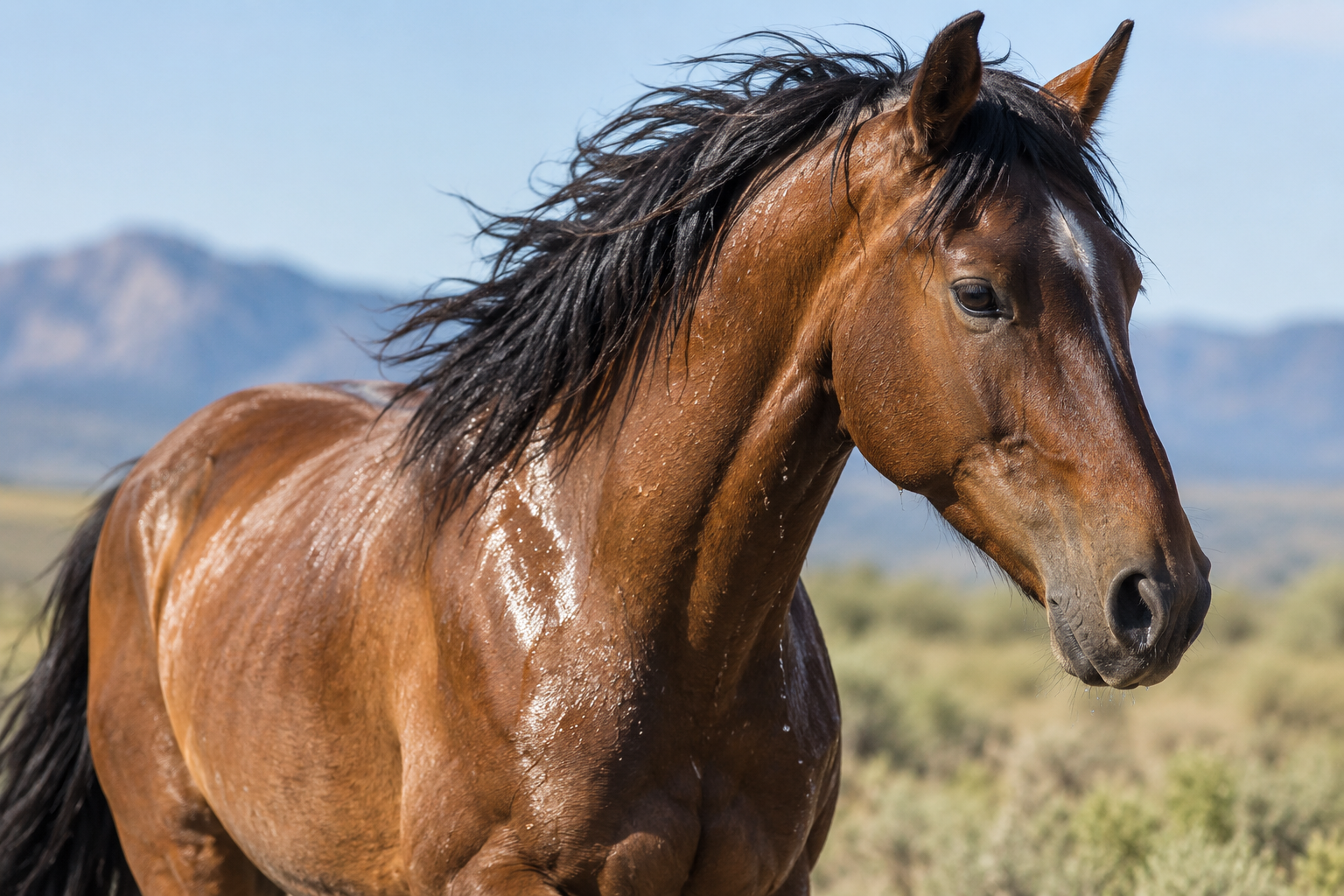
When a horse runs, its massive muscle bulk generates enormous amounts of heat. While horses do sweat, their thick coat traps heat, and their surface-area-to-mass ratio is low. As ambient temperatures rise, horses are forced to slow down to prevent lethal hyperthermia.
Humans, on the other hand, evolved as naked, upright persistence hunters. We possess 2 to 5 million eccrine sweat glands distributed across largely hairless skin. Sweat evaporates off our exposed skin, constantly dumping core body heat directly into the air. An amazing evolutionary adaptation.
The Hot-Day Rule: In cool weather, a horse almost always wins. But as the temperature approaches 27°C and higher, human sweating mechanics outmatch equine cooling capacity, rapidly closing the gap.
2. Respiratory Mechanics: Freedom vs. The Piston Effect
A running horse experiences an anatomical constraint called locomotor-respiratory coupling. When a horse gallops, the impact of its front hooves hitting the ground drives its internal organs forward against its diaphragm, forcing air out of its lungs. When it leaps forward, air is drawn in.
- Horse: Bound to a 1:1 ratio (1 breath per stride). They cannot adjust breathing independent of step cadence.
- Human: Completely uncoupled. Because we run on two legs, our lungs move independently of our footfalls. We can shift between 2:1, 3:1, or 4:1 breathing patterns depending on oxygen demand, terrain incline, or pacing strategy.
The Verdict
While horses remain the superior athletes over short and middle distances, human physiology is built for relentless, hot-weather endurance. When a person line up against a horse on a warm summer day over 32+ km, they aren’t just running a race—they are putting millions of years of evolutionary adaptation to the ultimate test.